

Emerald Pages
◆
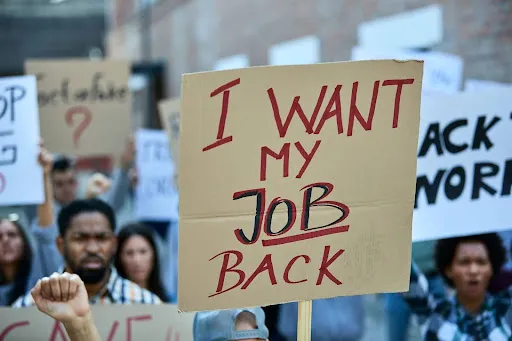
Photo: Freepik.
The numbers were supposed to be a milestone. In April 2023, under the Biden administration, the Black unemployment rate fell to 4.8 percent—the lowest ever recorded since the Bureau of Labor Statistics began tracking the data in 1972. It was a moment of celebration, a signal that decades of advocacy, tight labor markets, and targeted investment could finally move a historic needle. But less than three years later, that progress has been erased. By December 2025, the Black unemployment rate had climbed to 8.3 percent, erasing gains that took a generation to achieve.
The reversal did not happen by accident. It was the result of a rapid succession of policy shifts, federal workforce reductions, and economic realignments that hit Black workers harder and faster than any other demographic. To understand how we got here—from a historic low to a crisis level in under 12 months—is to trace the contours of a labor market where Black gains remain the most fragile, and Black losses the most severe.
The peak: April 2023
The 4.8% unemployment rate in 2023 was not a fluke. It came after years of tightening labor markets, infrastructure investments, and a concerted push for diversity hiring across both public and private sectors. Black women, in particular, saw record labor force participation. Black-owned businesses were accessing capital at unprecedented rates through programs like the State Small Business Credit Initiative. For a brief moment, the gap between Black and white unemployment—which has persisted for decades—narrowed to its smallest margin on record.
"We were finally seeing what happens when you run the economy hot and include everyone," says Dr. Michelle Holder, economist at John Jay College. "Employers couldn't afford to discriminate because they needed workers. That tightness created leverage for Black job seekers that we had never seen before." That leverage translated into wage gains, promotions, and a sense that the long arc of labor market justice might finally be bending.
The pivot: Early 2025
The landscape shifted dramatically in the first months of 2025. The new administration moved quickly to reverse many of the previous administration's economic policies. Federal agencies were directed to reduce headcount. Diversity, equity, and inclusion (DEI) programs—which had created pipelines for Black professionals into management—were scaled back or eliminated. Contracting goals for minority-owned businesses were deprioritized. The message from Washington was clear: the priority was shrinking government, not expanding opportunity.
"When you cut federal jobs, you're not just cutting Washington," explains Jared Bernstein, former Chair of the Council of Economic Advisers. "You're cutting in every state, every district. Those are teachers in military bases, researchers at NIH, administrators at HUD. And those jobs have been a ladder into the middle class for Black workers for generations." The federal workforce has long employed Black Americans at higher rates than the private sector—roughly 18% of federal workers are Black, compared to about 11% in the overall workforce. When layoffs came, they landed disproportionately.
- 4.8%: Black unemployment rate in April 2023 — the lowest in recorded history.
- 8.3%: Black unemployment rate by December 2025 — the highest since 2020.
- ~300,000: Black women who left the workforce in the first half of 2025 alone.
- 2.4x: The multiplier effect: Black unemployment now more than double the white rate (3.4%).
- First in, first out: Black workers were among the last hired during the recovery and the first fired during the contraction.
The ripple effect
The federal reductions were only the beginning. As DEI programs were rolled back in the private sector—many corporations following the federal lead—recruitment pipelines that had brought Black talent into tech, finance, and manufacturing began to dry up. Tariff policies implemented in mid-2025 disrupted manufacturing supply chains, leading to layoffs in sectors where Black workers had made recent gains. States that had expanded Medicaid and social services began trimming budgets, shedding public sector jobs that had provided stability in Black communities.
The compounding effect was devastating. By the third quarter of 2025, the Black unemployment rate had climbed above 7%. By year's end, it hit 8.3%. For Black women, the situation was even more acute: nearly 300,000 left the workforce entirely, many citing caregiving responsibilities as childcare subsidies were cut and remote work options disappeared. "It's not just that jobs vanished," says Holder. "The support systems that made work possible—childcare, transportation, flexible hours—were dismantled alongside them."
The response
In December 2025, Congresswomen Ayanna Pressley and Yvette Clarke sent a formal letter to the Federal Reserve, demanding action. "The 8.3% unemployment rate for Black workers is not just a statistic—it is a crisis," they wrote. "We call on the Fed to consider the disproportionate impact of its interest rate policies and to take immediate steps to prevent further harm." The letter was signed by dozens of lawmakers and supported by civil rights organizations, but the Fed's response was measured: inflation remained the primary target, they said, even if it meant sustained job losses for vulnerable groups.
On the ground, communities are organizing their own responses. In cities like Atlanta, Detroit, and Memphis, workforce development programs are scrambling to retrain displaced workers. Black-owned businesses are being urged to hire locally. And a new wave of migration—what some call the modern Great Migration—is seeing Black professionals relocate to Southern and Mid-Atlantic cities where job markets remain relatively strong. We can't wait for Washington to fix this. We have to build our own infrastructure, our own pipelines, our own safety nets. The $2.1 trillion Black dollar has to start circulating within our communities, not leaking out.
The lesson
The swing from 4.8% to 8.3% in under three years—and most of that in a single year—carries a stark lesson: Black economic gains, no matter how hard-won, remain fragile. They are subject to policy whims, political shifts, and economic currents that often treat Black workers as shock absorbers rather than stakeholders. The infrastructure that produced the historic low—tight labor markets, federal investment, anti-discrimination enforcement, targeted hiring—was dismantled faster than it was built. And the people who benefited most were left most exposed when the winds shifted.
The question now is whether the response will match the scale of the reversal. Will there be a new push for federal jobs guarantees? Will corporations reinstate diversity pipelines? Will Black communities succeed in building alternative economic institutions that can withstand political turbulence? Or will 8.3% become the new normal, a return to the historical average that prevailed before the brief, hopeful moment of 2023?
For the nearly 2 million Black workers now unemployed—and the hundreds of thousands who have stopped looking altogether—the answers cannot come soon enough. The $2.1 trillion Black dollar is still circulating. The question is whether it will flow into communities that need it, or continue to leak out at the fastest rate in a generation.
No Ads. By Us. For Us.
This article was only made possible by readers like you. We hope it inspired you to support Emerald Book, so we can continue producing content like this.
We will never show you ads, never sell your data, and never require a subscription to consume our content. Your gift helps us keep the truth accessible.
Please click the Support button on the bottom right of your screen to make a gift of any amount today.
Thank you for making this work possible.