

Emerald Pages
◆
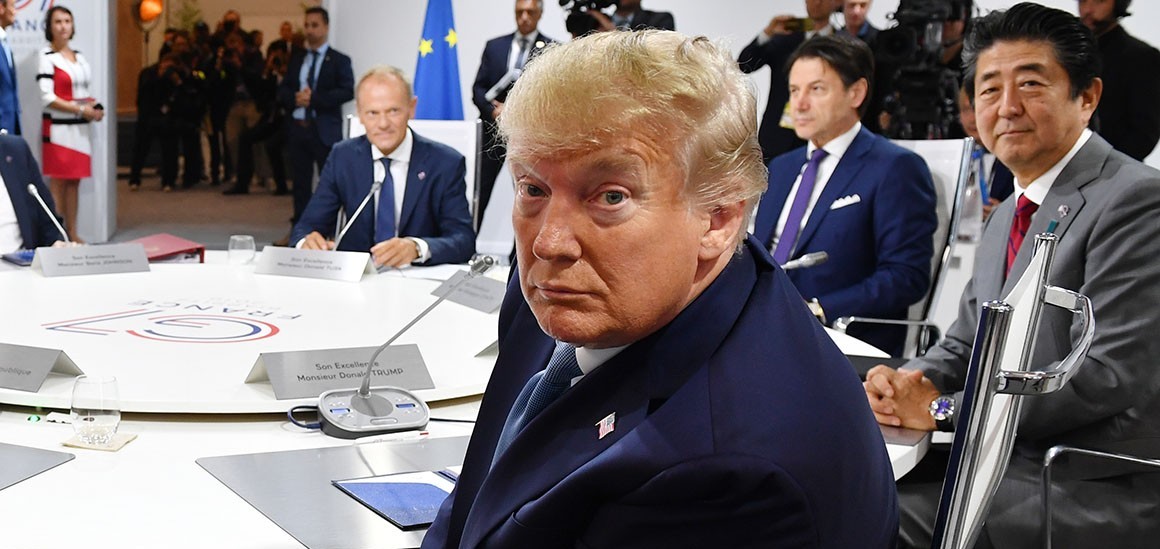
Photo: Jeff J Mitchell | Getty Images
There is a pattern that repeats itself every few years. Some aging white man in a suit—usually with a flag pin on his lapel and a teleprompter in front of him—stands before a camera and announces a war, a trade war, or an economic "adjustment." He speaks of national security, of protecting jobs, of making the economy "great again." Behind him, flags wave. Around him, other aging white men nod approvingly. And somewhere, far from the cameras, Black communities brace for impact. Because they know what the cameras never show: when these men play their games, Black people always lose.
The world is ran by dumb fucks—a blunt vernacular for the aging, out-of-touch white men who hold the levers of global power. From Donald Trump's trade wars to Vladimir Putin's invasions to the austerity policies of European leaders, these men make decisions that shatter economies, disrupt supply chains, and devastate the most vulnerable communities. And the question is always the same: guess who's affected? Black communities. Brown communities. Poor communities. The same people who have always been affected by the whims of men who have never worried about a grocery bill or a mortgage payment.
Trump's Tariffs: The First Shots
When Donald Trump launched his trade war with China in 2018, he framed it as a fight for American workers. He imposed tariffs on billions of dollars worth of Chinese goods—steel, aluminum, electronics, machinery—claiming it would bring manufacturing back to the United States. But the reality was far different. The tariffs didn't hurt China; they hurt American consumers. And they devastated Black-owned businesses.
Black entrepreneurs, who already face systemic barriers to capital and credit, suddenly saw the cost of their inventory skyrocket. A Black-owned clothing boutique that imported fabrics from China saw prices jump 25%. A Black-owned tech startup that relied on Chinese components saw production costs double. A Black-owned construction company that needed steel saw projects grind to a halt. The tariffs didn't discriminate—but the impact did. White-owned businesses had access to credit, to lawyers, to tariff exemptions. Black-owned businesses had none of that. They simply closed.
The Trump administration's trade war cost American households an estimated $1,400 per year in higher prices. For Black households—which already earn significantly less than white households—that was a devastating blow. Food prices rose. Clothing prices rose. The cost of everyday goods became a burden that white policymakers never had to consider. And when the tariffs failed to bring back manufacturing jobs—jobs that had left Black communities decades ago—the men who started the war simply moved on to the next crisis, leaving Black families to pick up the pieces.
Wars and Their Costs
The pattern is older than Trump. Every American war of the last fifty years—Vietnam, Iraq, Afghanistan—was started by white men in Washington and paid for by Black communities. Black soldiers die at disproportionate rates. Black families bear the burden of deployment. And when the wars end, the money that could have gone to Black schools, Black hospitals, Black infrastructure, has already been spent on bombs and aircraft carriers.
The Iraq War, launched by George W. Bush and a cabinet of white men, cost an estimated $3 trillion. That $3 trillion could have funded every HBCU in America for a century. It could have built affordable housing in every Black neighborhood in the country. It could have closed the racial wealth gap in a generation. Instead, it was spent on a war based on lies—a war that killed thousands of Black soldiers and left millions of Black families grieving while the men who started it collected speaking fees and wrote memoirs.
And it wasn't just America. Tony Blair, the British prime minister who followed Bush into Iraq, was another aging white man with a messianic complex. Vladimir Putin, the Russian president who invaded Ukraine in 2022, is another aging white man with a flag and a teleprompter and a willingness to destroy economies for his own ambition. Each of them made decisions that sent shockwaves through global markets—and Black communities, already precarious, felt every tremor.
- Iraq War (2003-2011): $3 trillion cost. Black soldiers made up 22% of the Army but only 13% of the population. Black families bore a disproportionate share of the human cost while white leaders profited from defense contracts.
- Afghanistan War (2001-2021): $2.3 trillion cost. Money that could have rebuilt Black communities was instead spent on two decades of occupation that ended in chaos.
- Trump's Trade War (2018-2020): Cost American households $1,400 annually. Black small businesses were hit hardest, with Black-owned firms 50% more likely to report supply chain disruptions than white-owned firms.
- Ukraine War (2022-Present): U.S. aid to Ukraine has exceeded $100 billion. While defending sovereignty is important, Black communities wonder why the same urgency isn't applied to crumbling schools, housing crises, and economic inequality at home.
- Iran War (2026-Present): Estimated $35+ billion so far, or roughly $1 billion per day. Over 11,000 munitions expended at $26 billion in first 16 days alone. Black families again bear disproportionate sacrifice while defense contractors profit from replenishing depleted stockpiles.
The Global Austerity Machine
Beyond wars and tariffs, there is the broader project of global austerity—pushed by aging white men in international institutions like the International Monetary Fund and the World Bank. For decades, these men have forced poor countries—many of them in Africa and the Caribbean—to cut social services, privatize public goods, and open their markets to Western corporations. The result has been the systematic extraction of wealth from Black-majority nations, enriching white executives and shareholders while leaving Black populations in poverty.
The IMF's Structural Adjustment Programs of the 1980s and 1990s are a textbook example. Imposed by white men in Washington and European capitals, these programs forced African nations to cut healthcare, education, and food subsidies in exchange for loans. The result was a lost decade of development, with African economies shrinking while Western banks collected interest. Today, the same dynamic plays out in debt negotiations, trade agreements, and climate finance—decisions made by white men in suits that determine whether Black children eat, whether Black farmers survive, whether Black nations develop.
The Cross Hairs Never Move
To understand why the Black economy is always in the cross hairs, you have to understand that this is not accidental. It is the deliberate, sustained work of a political class that views Black economic progress as a threat. Every major economic policy initiative of the last fifty years—from the war on drugs to the 1994 crime bill to the 2008 bank bailouts to the 2017 tax cuts to the 2023 assault on DEI—has been designed, debated, and passed by committees dominated by elderly white men who have never lived in a Black neighborhood, never sent a child to a predominantly Black school, never worried about a mortgage denial or a predatory loan or a police stop that ends in violence.
Consider the 2008 financial crisis. It was caused by white bankers and white regulators who deregulated the industry, approved predatory loans, and then collapsed the global economy. The response? White men in Washington bailed out the banks—the same banks that had redlined Black neighborhoods for decades—while Black homeowners were left to lose their homes. Black families lost 50% of their wealth in that crisis. White families lost 25%. The gap has never closed. And the men who caused it? They kept their bonuses. They kept their jobs. They are now advising the next generation of white men on how to run the economy.
Trump's Legacy: The Assault on DEI and Black Economic Mobility
Donald Trump didn't just start trade wars. He launched a full-scale assault on the mechanisms that allow Black people to build wealth. His administration rolled back fair housing rules, weakened the Consumer Financial Protection Bureau, and packed the courts with judges hostile to civil rights. His tax cuts funneled trillions to the wealthiest Americans while cutting services that Black communities depend on. And when he left office, he set the stage for the current assault on DEI—the latest front in a war that has been waged against Black economic progress for centuries.
The assault on DEI is the most recent example. After the murder of George Floyd, corporations and universities briefly committed to diversity. But the moment the pressure faded, the same geriatric white politicians who had spent decades opposing affirmative action launched a coordinated campaign to dismantle DEI programs. They framed it as a defense of "meritocracy"—a word that, in their mouths, means preserving the systems that have always favored people like them. The result is that Black professionals are losing jobs, Black students are losing scholarships, and Black businesses are losing contracts—all while white men continue to occupy the vast majority of positions of power.
The Global Picture: Putin, Brexit, and the White Male Chaos Machine
It's not just America. Look at Vladimir Putin, the aging white man in the Kremlin who launched a war that sent global food prices skyrocketing. Africa, which relies heavily on wheat imports from Russia and Ukraine, was hit hardest. Countries like Somalia, Nigeria, and Egypt saw bread prices double, triple, quadruple. Black families across the continent went hungry because one old white man decided to expand his empire. And what did the other old white men do? They sent weapons. They imposed sanctions. They turned it into a geopolitical chess game. But no one sent food. No one stabilized prices. No one asked about the Black families who were collateral damage.
Or look at Brexit. A referendum driven by aging white men in Britain who convinced their country to leave the European Union—with no plan, no economic analysis, no consideration for who would be hurt. The result was economic chaos, a collapsing pound, and rising costs for the poorest communities. And guess who was hurt most? Black Britons, who already faced higher unemployment, lower wages, and worse housing than their white counterparts. The men who led Brexit—Boris Johnson, Nigel Farage, Michael Gove—are all white. They are all wealthy. They all remain comfortable. The people who paid for their political ambition are Black.
Breaking the Cycle
The solution is not to wait for these men to die. There is always a younger white man waiting to take their place, shaped by the same ideologies, serving the same donors, protecting the same systems. The solution is to build power outside the institutions they control—to create Black-owned banks, Black-led businesses, Black-governed institutions that do not depend on their approval. It is to recognize that the cross hairs will never move on their own; we must move ourselves out of the line of fire.
This means supporting Black economic institutions—banks, credit unions, investment funds, business networks—that are accountable to Black communities rather than to white politicians. It means voting in every election, but also organizing beyond elections, building structures of mutual aid and economic solidarity that can withstand the whims of men who have never had our interests at heart. It means refusing to believe that the system will ever be fair to us, while simultaneously building a system that is ours.
The aging white men who rule the world have spent their lives perfecting the art of targeting Black people. They have used war, trade policy, austerity, and the law to extract wealth, break families, and suppress ambition. They will not stop. But we do not need them to stop. We need to build something they cannot control, something they cannot tax, something they cannot bomb. The cross hairs will always be there. The question is whether we are still standing in them.
So the next time you see the photograph—the row of old white men behind the mahogany desk, the podium with the flags, the teleprompter with the speech about "making things great again"—remember the question. The world is ran by unintelligent people. And guess who's affected? Always us. The question is whether we will keep waiting for them to change, or whether we will build a world where their decisions no longer determine our fate.
No Ads. By Us. For Us.
This article was only made possible by readers like you. We hope it inspired you to support Emerald Book, so we can continue producing content like this.
We will never show you ads, never sell your data, and never require a subscription to consume our content. Your gift helps us keep the truth accessible.
Please click the Support button on the bottom right of your screen to make a gift of any amount today.
Thank you for making this work possible.