

Emerald Pages
◆
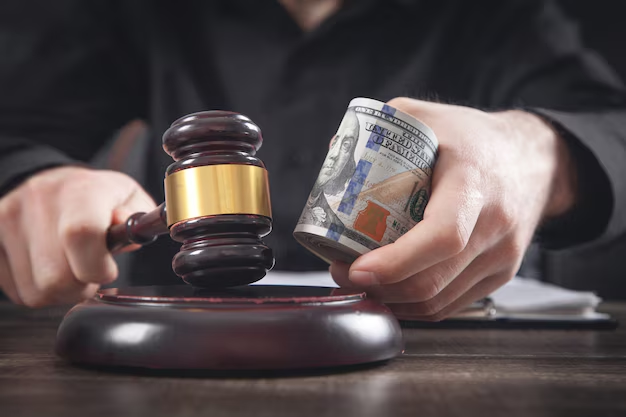
Photo: Freepik.
There is a parable repeated in barbershops and church basements across Black America. It goes like this: a seventeen-year-old Black kid from the projects gets caught with a few grams of marijuana and a stolen handgun. He is tried as an adult, sentenced to fifty-five years, and told he'll be eligible for parole when he's old enough to collect Social Security. Meanwhile, a fifty-five-year-old white financier in a tailored suit is caught embezzling billions—enough to fund public education in three states—and he serves five months in a federal "club fed" before returning to his penthouse. The parable is not fiction. It is the daily arithmetic of American justice.
The criminal legal system in the United States proudly wears the blindfold of impartiality. But anyone who has spent time in a courtroom knows the truth: justice isn't blind. She's nearsighted, and she sees clearly only when money is involved. The scales are not balanced by evidence and innocence; they are weighted by retainer fees, campaign contributions, and the quiet arithmetic of who can afford to buy their way out of accountability. For the wealthy, the law is a suggestion. For the poor—particularly poor Black people—the law is a trapdoor.
The numbers are staggering. According to the Sentencing Project, Black men receive sentences that are, on average, 19.1% longer than those of white men convicted of the same crimes. The United States Sentencing Commission has documented for decades that Black offenders receive harsher sentences than white offenders across virtually every crime category—even when controlling for prior criminal history and offense severity. A Black youth is more likely to be tried as an adult, more likely to receive a mandatory minimum, and more likely to serve the full term than a white peer charged with the identical offense.
The Mathematics of Inequality
Consider the case of a Black teenager in Florida who, in 2018, was sentenced to fifty-five years for robbing a convenience store of a few dollars and a bag of chips—his first offense. Compare that to a white investment banker who, in 2023, pleaded guilty to embezzling $47 million from a pension fund and was sentenced to eighteen months of house arrest. The teenager will likely die in prison. The banker will likely die on a golf course. The difference isn't the severity of the crime—it's the severity of the punishment available to those with resources to negotiate it away.
This disparity extends beyond individual cases to the very structure of the justice system. Wealthy defendants can afford private investigators, expert witnesses, and legal teams that cost more per hour than public defenders earn in a week. They can afford bail, meaning they await trial in their homes rather than in overcrowded jails where a defendant is far more likely to plead guilty just to get out. They can afford sentencing consultants who know exactly which words to say to a judge to minimize time. They can afford to pay fines that would bankrupt a working-class family, turning a felony into a misdemeanor and a prison sentence into a probationary slap on the wrist.
- Bail Disparity: The median bail amount for a felony is $10,000. Sixty percent of the jail population is awaiting trial—not convicted—simply because they cannot afford bail.
- Public Defender Crisis: The average public defender handles over 2,000 cases per year—impossible to give any single case adequate attention. Private attorneys handle fewer than 50.
- Financial Crimes vs. Street Crimes: The average sentence for bank fraud is 2-3 years. The average sentence for selling $50 worth of drugs is 5-10 years. One harms the economy; the other harms the "community" where the sentence is served.
- White-Collar Leniency: According to the U.S. Sentencing Commission, 64% of white-collar offenders receive sentences below the federal guidelines. Only 27% of drug offenders receive the same leniency.
The Pedophile and the Pension Thief
Perhaps no comparison better illustrates the absurdity of American justice than the sentencing gap between violent sex offenders and white-collar criminals. In 2022, a former hedge fund manager convicted of defrauding investors of $1.2 billion received a sentence of four months in a minimum-security prison—the kind without bars, where inmates wear their own clothes and have access to golf courses. The same year, a nineteen-year-old Black man in Louisiana received a sentence of forty years for a nonviolent drug offense—his first arrest.
The message is unmistakable: steal a billion dollars, and the system treats you with kid gloves. Steal a pair of sneakers, and the system treats you like a predator. This isn't an accident. The financial industry has spent decades lobbying for reduced penalties for white-collar crimes, arguing that "non-violent" financial offenses should be treated with leniency. Yet those same lobbyists support mandatory minimums for street crimes—the kinds of crimes poor people commit when the legitimate economy refuses to employ them.
Consider the case of a former Catholic priest convicted of sexually abusing dozens of children over a twenty-year period. His sentence? Five years of probation and a requirement to attend counseling. No jail time. The court cited his "advanced age" and "history of community service." Meanwhile, a twenty-year-old Black man in Mississippi received a fifty-year sentence for stealing $150 worth of power tools—the same judge noting his "lack of respect for property rights." The priest stole innocence; the young man stole tools. One was given mercy; the other was given a life sentence.
Why the System Is Designed This Way
This is not a failure of individual judges or prosecutors. It is a feature of a system built to protect capital. The wealthy—who donate to political campaigns, who employ the children of judges, who sit on the boards of the corporations that fund the legal system—are not going to prison for long. The poor—who cannot donate, who do not have connections, who are disposable—are the raw material that fuels the prison-industrial complex. Private prisons need bodies. Chain gangs need laborers. The system requires a steady supply of poor people to lock up, and the easiest way to generate that supply is to criminalize poverty itself.
The result is a two-tiered justice system so stark that it borders on parody. A Black teenager caught with a bag of weed faces more prison time than a white financier who collapsed a pension fund and stole the retirement of thousands. A mother who uses a false address to enroll her child in a better school can be charged with felony fraud and face years in prison. A bank executive who falsifies thousands of mortgage documents to inflate stock prices receives a bonus and a golden parachute.
The courts are not neutral arbiters of justice. They are auction houses where the highest bidder buys the lightest sentence. The poor receive "justice" in the form of mandatory minimums and public defenders who meet their clients for the first time in the hallway before trial. The rich receive "justice" in the form of plea deals negotiated by armies of lawyers who have known the prosecutor since law school. The scales are not balanced; they are for sale.
The Cost of Injustice
This disparity has devastating consequences for Black communities. Mass incarceration has stripped generations of Black men from their families, their neighborhoods, and their economic futures. A criminal record in America is a lifelong sentence to poverty, homelessness, and disenfranchisement. And the crimes that trigger these sentences are often minor—nonviolent drug offenses, petty theft, property crimes committed out of desperation. The system takes a child, sentences him as an adult, and releases him—if it releases him—as an old man, broken, unemployable, and stripped of any chance at a normal life.
Meanwhile, the wealthy white men who commit actual economic violence—who steal homes, who loot pensions, who defraud the elderly—are treated with deference. Their crimes are called "mistakes" or "oversights." Their sentencing memos are filled with letters from college friends and business partners attesting to their character. They serve their time—if they serve any—in facilities that look like college dorms. They return to their lives, their wealth intact, their reputations polished by public relations firms that spin fraud into "aggressive business practices."
Reclaiming Justice
The solution is not reform—reform is what gave us this system. The solution is transformation. It requires abolishing cash bail, which criminalizes poverty. It requires ending mandatory minimums, which handcuff judges and give prosecutors unchecked power. It requires adequately funding public defender offices so that poor defendants receive the same quality of representation as wealthy ones. It requires sentencing guidelines that treat financial crimes with the same severity as street crimes—because stealing a billion dollars is not a "victimless crime"; it is violence on a massive scale.
Most of all, it requires acknowledging the truth that every Black parent knows and every white judge pretends not to see: that justice in America is not blind. It is a game where the rules are written by the wealthy, enforced against the poor, and adjudicated by a system that profits from keeping it exactly as it is. The blindfold has always been a lie. The question is whether we will finally remove it—and see the system for what it truly is.
No Ads. By Us. For Us.
This article was only made possible by readers like you. We hope it inspired you to support Emerald Book, so we can continue producing content like this.
We will never show you ads, never sell your data, and never require a subscription to consume our content. Your gift helps us keep the truth accessible.
Please click the Support button on the bottom right of your screen to make a gift of any amount today.
Thank you for making this work possible.